One Letter That Changes Everything: The Story of Sickle Cell Disease
How a single-letter change in the DNA causes sickle cell disease, why the mutation persists (a remarkable malaria trade-off), and how CRISPR gene editing is turning that one letter from a life sentence into something we may be able to correct.
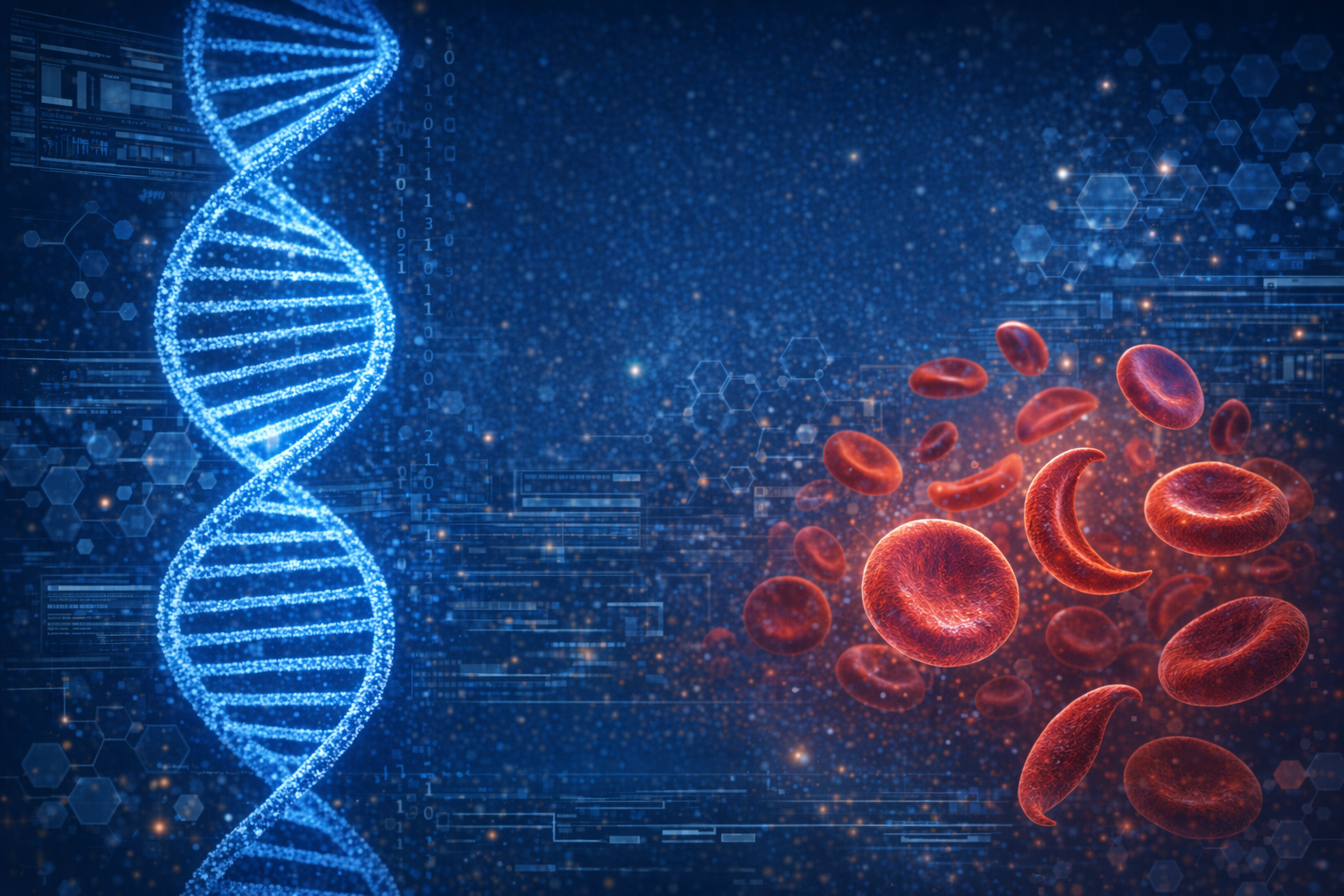
One Letter That Changes Everything: The Story of Sickle Cell Disease
In my last post (Finding the Needle in the Genomic Haystack), I talked about how a single genetic variant can hide among millions of harmless ones in the human genome.
Sometimes, however, we already know exactly which variant causes the disease.
Sickle cell disease is one of the most famous examples.
🧪 The Mutation Behind the Disease
Sickle cell disease is caused by a mutation in the HBB gene, which encodes the beta‑globin protein - a key component of hemoglobin.
Hemoglobin is responsible for transporting oxygen in our red blood cells.
In this case, a single nucleotide change alters one amino acid in the protein: glutamic acid becomes valine.
It sounds like a tiny change.
But this single substitution alters the physical properties of hemoglobin. Under certain conditions, the mutated hemoglobin molecules stick together and form long fibers inside red blood cells.
As a result, the cells - which are normally round and flexible - become rigid and sickle‑shaped. (Source: Development of β-globin gene correction in human hematopoietic stem cells as a potential durable treatment for sickle cell disease)
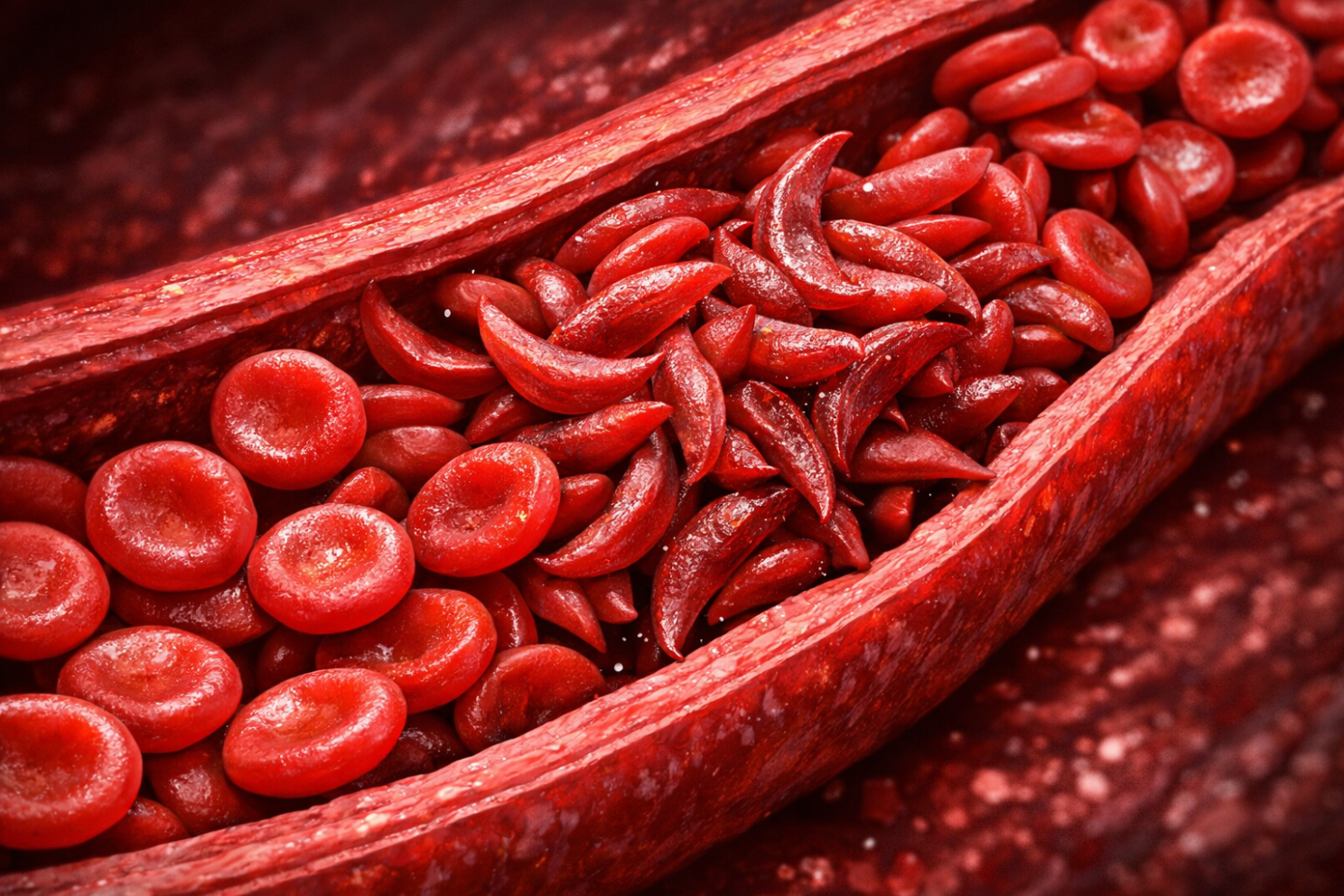
AI‑generated illustration of sickle cell disease inside a blood vessel, showing crescent‑shaped red blood cells clustering together and blocking blood flow while normal round red blood cells pass through the vessel.
🩸 Why Shape Matters
These distorted cells can clog small blood vessels and break apart more easily.
The consequences are severe: pain crises, reduced oxygen delivery, organ damage, increased infection risk, and shortened life expectancy.
Although sickle cell disease is considered rare in Europe, it is much more common in parts of sub‑Saharan Africa. (Source: WHO)
The reason is a remarkable example of evolutionary trade‑off.
🌍 The Malaria Connection
Sickle cell disease is an autosomal recessive condition, meaning a person must inherit two copies of the mutated gene to develop the disease.
However, individuals carrying only one copy, so‑called carriers, gain significant protection against severe malaria. (Source: Sickle cell anaemia and malaria)
This protective effect gave carriers a survival advantage in regions where malaria is endemic.
Over generations, this led to a higher frequency of the mutation in these populations.
Today, an estimated 515,000 babies are born with sickle cell disease every year, many of them in sub‑Saharan Africa. (Source: WHO)
In some regions, 50–90% of affected children die before reaching adulthood. (Source: The epidemiology of sickle cell disease in children recruited in infancy in Kilifi, Kenya: a prospective cohort study)
🧬 Editing the Mutation
During many of my talks, a question comes up again and again:
If we know the exact mutation that causes a disease, can we simply fix it?
For disorders caused by a single nucleotide variant, this idea is particularly appealing. If one letter in the genome causes the disease, then correcting that letter could, in principle, remove the problem entirely.
For a long time, this sounded more like science fiction than medicine.
But over the past decade, a technology called CRISPR‑Cas9 has changed that.
In 2020, the Nobel Prize in Chemistry was awarded to Emmanuelle Charpentier and Jennifer Doudna for developing this revolutionary gene‑editing method. CRISPR allows scientists to cut DNA at a precise location and modify the sequence opening the possibility of directly correcting disease‑causing mutations. (Source: The Nobel Prize)
Sickle cell disease is one of the first examples where this idea has moved from theory into clinical practice.
The first CRISPR‑based therapy for sickle cell disease, Casgevy, has already been approved. (Source: FDA)
However, the treatment currently costs around $2.2 million per patient. (Source: Affordable Pricing of CRISPR Treatments is a Pressing Ethical Imperative)
🇮🇳 A Different Approach
Two years ago, I had the opportunity to attend a workshop at CSIR‑IGIB in New Delhi, where I met Dr. Debojyoti Chakraborty.
Debo was incredibly kind and took the time to show us around and explain his work in detail.
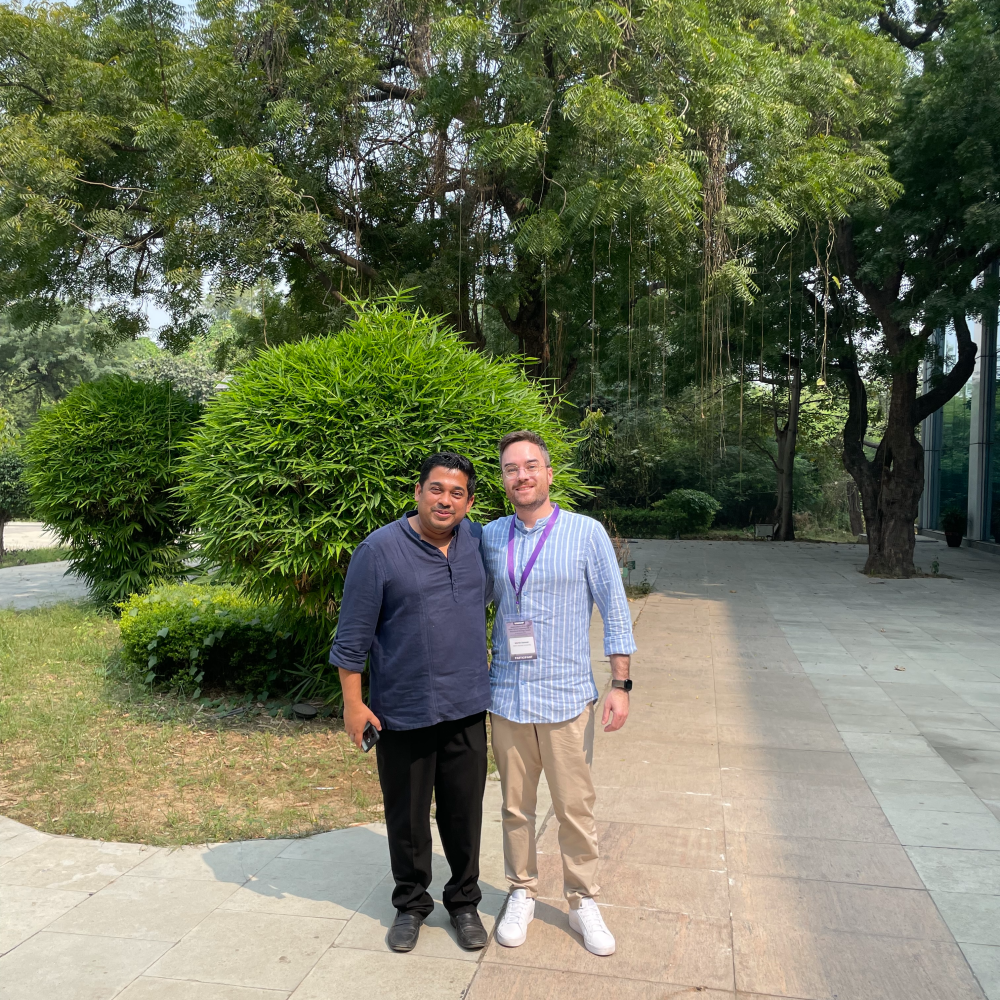
Photo of Dr. Debojyoti Chakraborty and me standing in front of the CSIR‑IGIB (Institute of Genomics and Integrative Biology) building in New Delhi during a workshop visit.
It was one of those encounters you remember years later.
If you happen to read this, Debo - thank you again for that experience. 🙂
He and his colleagues are developing an indigenous CRISPR‑based therapy called Birsa‑101, designed to correct the sickle cell mutation. (Source: Birsa-101: India’s Path Towards Affordable CRISPR Therapies)
The therapy is currently in clinical trials and aims to reduce treatment costs dramatically - potentially by up to 40‑fold.
The project is part of India’s National Sickle Cell Anaemia Elimination Mission, launched in 2023, which aims to eliminate the disease in India by 2047.
If you would like to dive deeper into the technology and Debo’s research, I can recommend the following paper published in Nature Communications: PAM-flexible Engineered FnCas9 variants for robust and ultra-precise genome editing and diagnostics.
🔬 From Variant to Cure
For me, this experience made one thing very clear:
A single letter in the genome can cause devastating disease.
But the combination of genomics, biotechnology, and increasingly machine learning may also allow us to fix it.